[Alrighty gear heads. Erik here with a continuation of the series of posts where I elaborate on the gear that I consider essential for my video job here at CJinc. I previously discussed how the Zaucto Z-Finder helps me guarantee the visual quality of my video, and in this post I'll explain how the Rode Stereo Video Mic ensures that my BTS footage will have respectable sound too. Perhaps more importantly though, how it allows me to take my mind off of capturing audio and instead focus it on staying creative while shooting.]
If you’ve seen our D7000 video, you’ve heard this microphone. Every bit of audio in that video, minus Chase’s opening narration and the music, was captured with the Rode. In fact, we put it to use on nearly every behind the scenes video we make. From the mountains in Telluride to the South China Sea, this mic has withstood it all. Much like the Zacuto Z-Finder that I wrote about in my first post, what I love about the Rode SVM is its simplicity. Before I get into the details, I feel like I should back up a little and explain why it’s needed in the first place……
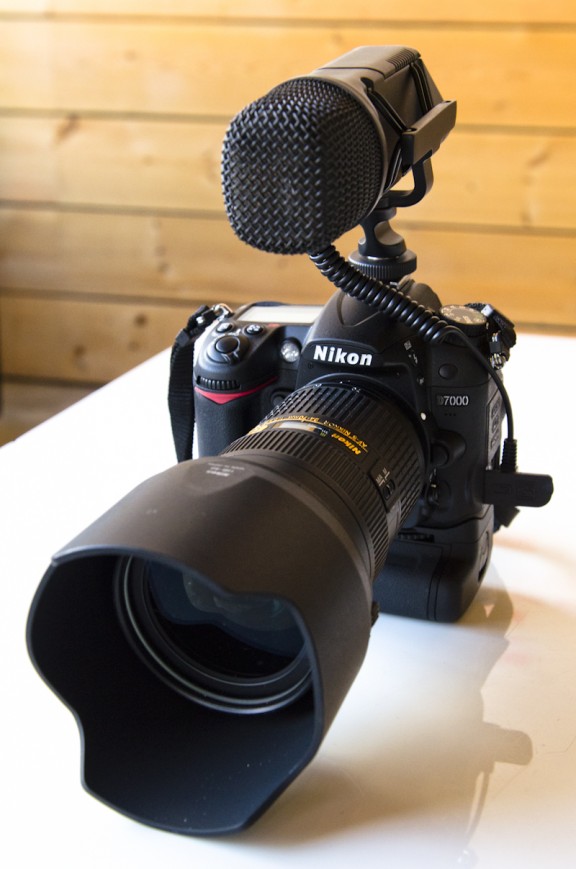
Built-in camera microphones are crap. They pick up every bump and tap that occurs naturally as you handle the camera. They’re especially bad on DSLR’s where they’ll pick up the sound of the lens’s autofocus motor and image stabilizer you may be using. If you’re using the onboard microphone on your DSLR and you’re wondering why your footage sounds like it’s inside a coffee grinder, look no further than that little Image Stabilization switch on the side of your lens. The bottom line is that, in all of these cases, if you want usable sound, you have to use an external microphone.
Notice I said “usable sound” and not “good sound” or “perfect sound” (the latter two require a dedicated audio tech and separate gear…). That’s because most DSLR’s aren’t really built to capture great audio. But, in many cases, especially for BTS footage, this audio is completely acceptable. Most DSLRs rely on AGC (automatic gain control), which means the camera just goes ahead and sets whatever audio level it feels is appropriate. Some cameras will let you set an audio level manually, but since DSLRs don’t have the kind of real estate to leave room for audio level knobs on the outside of the camera, that manual control is buried under at least a couple of menu screens and thus, in my opinion, is useless. If I can’t adjust that manual setting while I’m shooting, I don’t need it.
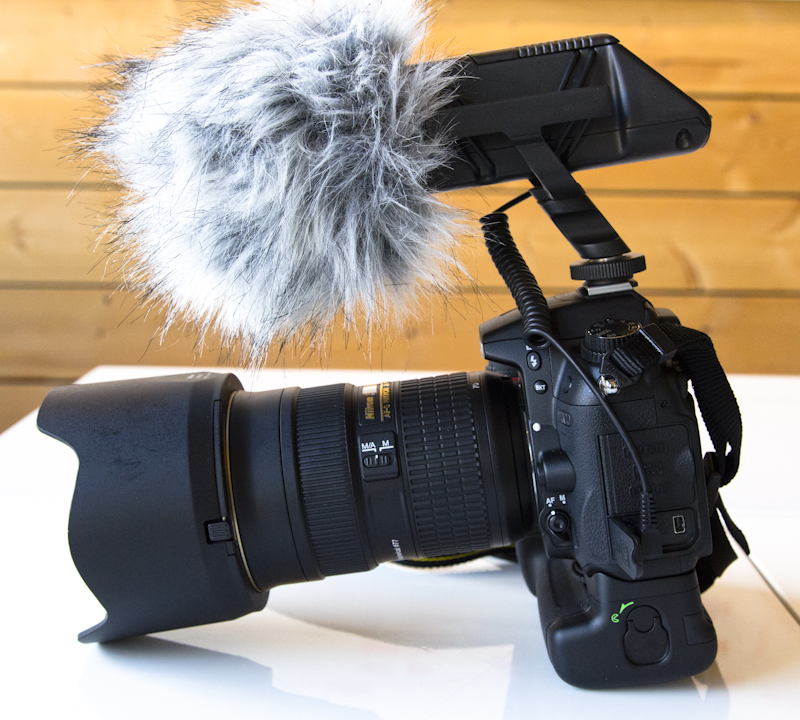
The Rhode mic with it's "dead kitten" windscreen.
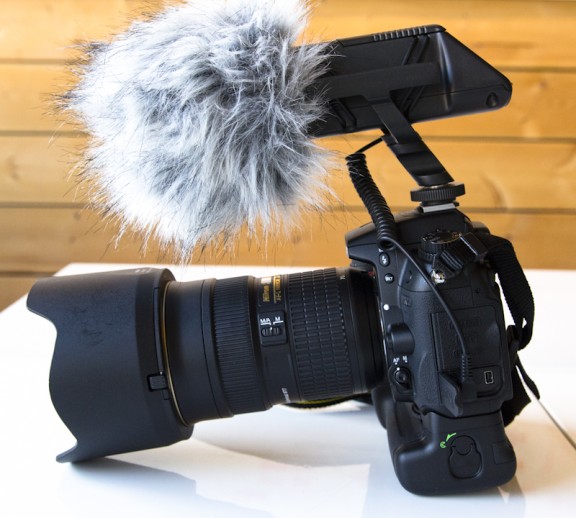
All this AGC and lack of immediate audio control isn’t such a bad thing though. Remember at the start of this post when I said the Rode SVM let’s me take my mind off of audio and focus it on shooting creatively? I like that I can’t control the audio when I’m shooting with a DSLR. It’s liberating, and I’ve shot enough with these cameras and this microphone to have a *pretty good* idea as to what it’s gonna sound like when I drop it into Final Cut Pro. The mic is simple and reliable.
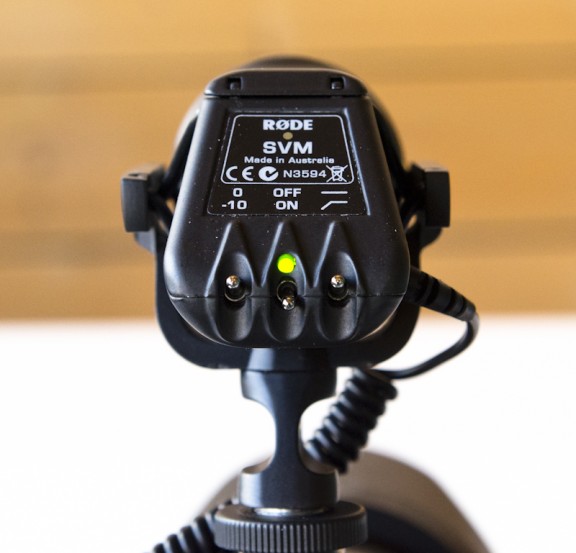
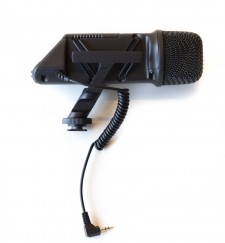
Speaking of simple, here’s the rundown of the controls of this beauty. It has a nice big LED on the back of it, right in front of my face, that let’s me know that it’s on. It has a power switch, a -10dB pad switch, and a high pass filter switch, and that’s all I need. And actually, to be honest, I don’t usually take notice of the position of any of the switches other than the power switch. I should mention at this point that, for the most part, we use this microphone to shoot behind the scenes videos which are typically a little rough around the edges (which is our style), and thus the audio isn’t particularly critical. When audio is critical, such as an important interview, a short film or commercial with dialogue, or a voice over type narration, we do one of two things; hire a professional sound person or record it ourselves with high end mics and audio booms, even a Zoom H4n. The Zoom H4n is an amazing gadget, but I’ll talk about that in a future post…
The Rhode SVM is available for $249 from B&H Photo.





Nice compact mic unit. When you talk about the Zoom H4N let us know if you think it actually does anything that my IPhone 4 can’t do with a recording app and an external mic.
oh please! you iphone people think that’s the best device in the world. There is no way that your iphone is better than an SLR. If you actually believe that you’re a talentless buffoon.
hmmm…. iPhone vs Zoom H4n. Off the top of my head I’d say the most important thing is quality pre amps. Meters, XLR inputs, 48khz, multitrack with separate levels, are all key things to make the work easier and more consistent, but at the end of the day if the audio doesn’t sound good it’s worthless. I love my iPhone too, but I’d never rely on it to record a real project.
Looking forward to what you guys use for audio mics.
And one interesting question: if you could hotshoe mount the H4n, why would you use the Rode Stereo Videomic?
We use the Rode on camera as opposed to the H4n mostly because of the simplicity of the Rode. The Rode is also a lot more weather proof than the H4n.
Love the Rode SVM mic – I use it at school and on personal shoots – always delivers great audio. I do also use a Zoom H4N (hint: Phantom Power, XLR & 1/4″ mic jacks, built in stereo, 4 ch mixer) for when I need the upper end audio.
I look at the Rode SVM like my computers – “It just works” and doesn’t get in my way when working.
Couldn’t agree more about Rode’s reliability… Personally, I love the VideoMicPro: Same features, a little more fragile but also designed for slightly different purposes. As far as on-camera mics go, rode is the way to be.
Eric-
Do you use the bracket that attaches to the bottom of the camera to mount your Zacuto? Even with the grip?
What advantages do you see in using the grip other than battery life? Is it easier or harder to manage the camera?
Thanks for the feedback.
Yep, we use the bracket that extends down past the grip. Most of our cameras have the sticky frame stuck to them though, so the bracket is only used with rental cameras (ie – rarely). Battery grips give the camera more weight, which improves stability in my opinion. They also make the camera a little taller which helps for tripod shooting and some shoulder rigs.
Awesome info! Thanks so much for posting!
I have tried using a sennheiser in the hotshoe mount but what I like about the Rhode VMC is the Integrated Shockmount. It rocks.
Thanks a ton Erik!! Really appreciate the help.
Great post, Erik! I was curious about the D7000 video rig! It looks like a great thing. Just one question:. “… a high pass filter switch…”?!! What is that??? Thanks for sharing and thanks in advance!
Please take some time to relax, you hardworking guys!
Thanks for the post, I am about to buy a smaller Tascam D-05 for my HDSLR audio needs.
On the topic of video. When you folks are doing the run and gun thing, do you find yourselves need more than the view finder and your two hands for stabilization?
A shoulder rig seems overkill for what I want to do – capture video that doesn’t make people sick, but I’m not going for an Oscar either – so I wonder if a set of handles under the camera would suffice. Thanks!
Hey Blair, I totally agree about shoulder rigs vs. hands and a viewfinder. I only use a shoulder rig if I think I’m going to have to hold a shot for an extended period of time (like an interview for example).
Hey Eric,
I just ordered this Cinevate grip: http://vimeo.com/14220163
I figure that, with a griped camera, mic and eyepiece should be a decent amount of heft while retaining portability. Plus, honestly, and all of you can flame me on this. A lot of these rigs make you look like a total freak, not a big deal if you are working with models and actors, but if you are trying to capture family and people on the street or at a professional conference I want to be as subtle as possible with my kit.
Coincidently, this is also why I chose to not go for an external recording solution like a Tascam or Zoom. I figure what is posted here is “good enough.”
Hello !
Thanks for your blog-entry.
I have to buy a external mic too… now Rode has build the new “VideoMic Pro”:
http://rodemic.com/microphone.php?product=videomicpro
Did anyone get this one or know the difference between the new one, the old one and this SVM ?
Which one is the Best to buy ?
Thanks for your help and greetings from Germany !
René
The Rode VMP is Mono, but it duplicates the sound over both channels. The Rode SVM records two separate channels.
I bought myself the VMP because I am typically aimed directly at the subject, but if you have multiple subjects, stereo sound can give your footage some more dimension. The VMP also has the option for a +20 gain setting in addition to the -10—I like this when I know I am going to be further away or someone is speaking quietly.
The VMP is also much smaller, it is a bit shorter (much shorter than the normal VideoMic), about half as wide, and much better balanced vertically… I moved my lens insert just about a half inch from the side of my camera bag and am able to wedge my VMP in there so I have it with me at all times… there’s never an excuse to not have usable sound. I have a feeling it would feel like a chore for me to have to lug the SVM around, but I don’t imagine Chase and crew really worry about this much of a size difference, or the small difference in price ($20 + free deadcat w/ VMP)
As usual…a PS.
Some trivia: Did you know that ” Røde” …” Rode” ( written with the exclusive Danish letter “Ø”, as marked on top of the mic ) means ‘the Red” in Danish?
I haven’t got a clue why… but I’m Danish so I would spot it in a split second
Nice piece of kit. Condenser mic yeah?
The normal videomic is a good option as well, and there is a new one now especially for DSLRs.
Thanks a lot for this post….I have been researching proper video mics for my Camera….
Appreciate it.
I have the Zoom H4N so I’ll be waiting for your next post. Thanks for these insights tho. I love the audio on your behind the scenes videos and now I know you dont use some huge audio gear, it gives me more confidence that decent quality audio can come from something so simple as this microphone
When shooting video with the Rode, what audio setting do you use on the D7000?
Thanks for the write up, I have been looking into recording options now that I have a HDSLR. I will definitely keep this one in mind.
He Eric,
Good post, and pretty okay mic. I have it myself, but I do think their are some issues nobody adresses. Any ideas?
- I hear a slight “hummm” in the recording, some sort of buzz. Can’t get it out. I use the Canon t2i with Magic Lantern.
- When I operate the camera or change something on the lens, e.g. zoom or focus, the mic will pick that ‘fondling’ sound up. How do you work around that?
Thanks, and looking forward to any other insights!
P
The solution is to never mount the mic on the camera if at all possible. You’ll get much better sound attaching your Stereo VideoMic to a boom pole or mic stand (if they’re stationary) and placing above the subject.
NOt much for the kind of sound it give.
only 249$! It fits perfect with my new D7000
:) i have it for two days and its amazing machine! Love the AF !!!!!!
Can I get someone to snap a pic of the contacts for the battery in the compartment? I think mine might be bent from the factory. Best way to reach me is Twitter @blaircook
Virtual private server hosting news, reviews, deals, and updates from an industry-leading provider.
I had the chance of trying this mic from a friend, but it didn’t fit the hotshoe of my D7000? It would slide halfway in, but was way too tight to go any further. Any experiences on that?